Lesson and quiz, category B licence

Priority signs (Segnali di precedenza)

On the exam this topic tests the signs that decide who goes first: give way, stop, priority road, their advance warnings and single file narrow sections; this site has 22 true or false statements to practise on it.

The theory exam has 30 statements in 20 minutes and you pass with at most 3 mistakes. Source: Codice della Strada.

Skip to the quiz Study the rules

The real theory exam is in Italian, with French or German available on request. Lessons here keep the Italian terms in italics, and the quiz shows each statement in Italian with English help underneath. Switch to Italian only in the quiz to practise under exam conditions.

The rules

Question 1 of 1

Rule 1

Give way: slow down and yield

The triangle pointing down, with a red border and white background, requires you to let traffic on the crossing road pass. It does not require a stop: you stop only if something is coming. It stands on the road that must yield, the minor one, and on the ground it goes with a broken transverse line. The downward point sets it apart from warning signs, which point up.

Example

You reach the inverted triangle and the main road is clear for hundreds of metres both ways. You slow down, look, and pull out without stopping.

Legal reference: CdS art. 145, c. 4; Reg. art. 106

Give way
Give way (Dare precedenza)

Exam traps

  • «You must sempre (always) stop»: false, you stop only if vehicles are coming.
  • «It is placed on the main road»: false, it stands on the road that yields.
  • «It comes with a solid line»: false, the solid line belongs to the stop sign.

Rule 2

Stop: always halt

Stop is a priority sign, not a prohibitory one. Its octagonal shape is unique, so it can be recognised from behind or when faded. It requires you to halt in every case, even with perfect visibility and an empty road, before the solid transverse line or, if there is none, before the point where the carriageways cross. After stopping you give way and, if you cannot see well from where you stopped, you edge forward carefully without entering the junction.

Example

At night in the countryside the stop sign stands at a junction with a long view and nobody coming. You come to a full halt at the line, look, then move off.

Legal reference: CdS art. 145, c. 5; Reg. art. 107

Stop
Stop (Fermarsi e dare precedenza)

Exam traps

  • «It is a prohibitory sign»: false, stop is a priority sign.
  • «With perfect visibility slowing right down is enough»: false, a full stop is always required.

Rule 3

Advance warnings and signed junctions

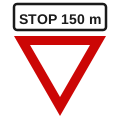
Where visibility is limited, give way and stop signs are announced in advance. The advance give way sign is the same inverted triangle with a distance panel; the advance stop sign is an inverted triangle with the word stop and the distance. The advance sign does not require you to stop where it stands: you stop at the real sign. The warning triangle with a black cross, by contrast, announces a junction with no priority signs, where the right hand rule applies.

Example

After a blind bend comes an inverted triangle reading stop and 150 m. You start slowing down and halt 150 metres further on, at the solid line.

Legal reference: CdS art. 145; Reg. art. 106; Reg. art. 107

Stop ahead
Stop ahead (Preavviso di fermarsi e dare precedenza)

Exam traps

  • «The advance stop sign means stop where it stands»: false, it announces the stop further on.
  • «A stop sign can mai (never) be announced in advance»: false, the advance sign exists for poor visibility.

Rule 4

Priority road and priority junction

A yellow diamond with a white border marks a priority road, valid until the end sign, which is the same diamond crossed out; the edge of a built up area does not end it. The priority junction sign stands on the road that has priority and warns that a minor road is about to cross. In both cases priority is about who goes first, not about speed: near junctions you slow down and stay ready to stop. After the end sign the right hand rule or the signs in place apply.

Example

You are on a provincial road marked with the yellow diamond and enter a village. Priority continues inside the village until the crossed out diamond appears.

Legal reference: CdS art. 145, c. 1; Reg. art. 104

Priority road
Priority road (Diritto di precedenza)

Exam traps

  • «You may cross senza alcuna attenzione (without any care)»: false, the duty of care remains.
  • «It lasts until the end of the built up area»: false, only the end sign ends it.
  • «The priority junction sign is placed on the minor road»: false, it stands on the main road.

Rule 5

Single file narrow sections

At narrow sections where only one vehicle can pass at a time, two matching signs are used. Give way to oncoming traffic, a red bordered disc with two arrows, the red one pointing towards you, requires you to wait for vehicles coming the other way. Priority over oncoming traffic, a blue square with the larger white arrow, lets you enter the narrow section first. The first sign stands at one end of the narrow section, the second at the other.

Example

A narrow bridge over the Adige has the disc with the red arrow on your side. You wait at the entrance until the oncoming car has crossed, then go.

Legal reference: Reg. art. 115

Exam traps

  • «The give way to oncoming traffic sign gives priority to whoever faces it»: false, it requires you to yield.

Rule 6

The road lines that go with the signs

On the carriageway a broken transverse line goes with the give way sign and shows where to yield, with no duty to stop. A solid transverse line goes with the stop sign and marks the exact point where you must halt.

Example

The sign is hidden by branches, there are no lights and a solid line crosses the lane. The line marks a duty to stop, so you halt before it.

Legal reference: CdS art. 40

Exam traps

  • Solid means stop, broken means yield: a statement that swaps the two is false.

Rule 7

What can go wrong

Three scenes show what happens when a priority sign is misread. First scene: in the countryside near Mantua a lane meets a provincial road at a stop sign. It is Sunday morning, visibility is perfect and the driver slows to walking pace without stopping. A motorcycle coming fast from the left, hidden until then by a row of poplars, brakes and slides. The rider injures a shoulder and the offence is the driver's who did not stop, because art. 145 of the Codice della Strada requires a halt at a stop sign in every case, then giving way. Second scene: on the via Aurelia, near a village in the Maremma, the driver is on the state road marked with the yellow diamond and reaches a junction at 90 km/h. A tractor pulls out slowly from the minor road and the driver, sure of their right of way, does not slow down. Braking would have avoided the crash. Priority says who goes first; it does not allow a speed that makes stopping for a foreseeable obstacle impossible, and a driver arriving too fast can be given part of the blame. Third scene: at a narrow bridge in the Val di Non, one end carries the disc with the red arrow. The driver reads it as being in their favour and drives on. Halfway across they meet a van that had the blue priority square, and one of them has to reverse between two parapets. The give way to oncoming traffic sign requires waiting until the narrow section is clear. The shared lesson is simple. At a stop sign you always halt, at the inverted triangle you yield without having to stop, and priority never cancels the duty to slow down at junctions.

Legal reference: CdS art. 145

CdS: Codice della Strada (d.lgs. 285/1992). Reg.: its implementing regulation (d.P.R. 495/1992). c.: comma, the numbered paragraph of an article.

Full text of the Codice: www.aci.it/i-servizi/normative/codice-della-strada.html

Trap words

False statements on the exam often repeat a true rule and change a single word. These are the Italian words to read carefully in this topic. They stay in Italian because that is how they appear on the exam.

Words that appear in every topic

sempre
always. An absolute: the statement is true only if there is no exception at all.
«Keeping to the limit sempre (always) guarantees a safe speed»: false, in fog or on ice you go slower.
solo, soltanto, esclusivamente
only. It rules out every other case, so a single exception makes the statement false.
«The children sign is placed soltanto (only) outside primary schools»: false, it also appears near parks and sports grounds.
mai, in nessun caso
never, in no case. The statement is true only if the behaviour is not allowed in any situation.
«A driver with priority may in nessun caso (never) give it up»: false, they may, as long as they make it clear.
ovvero
In the language of the Codice it means «or» and introduces an alternative. It does not mean «that is».
Emergency stop: the vehicle has broken down ovvero (or) the driver must stop because they feel unwell (art. 157). Two separate cases; either one is enough.
obbligatoriamente, è obbligatorio
compulsory. A duty: it is not enough for the behaviour to be allowed, it must be required.
«Overtaking on the left is obbligatorio (compulsory) even past a driver turning left»: false, in that case you pass on the right.
è consentito, è ammesso
allowed, permitted. A permission, not a duty. «È consentito» does not mean «è obbligatorio», and the reverse.
«It is consentito (allowed) to pass on the right a driver who has signalled a left turn»: true, and art. 148(7) actually requires it.
di norma, di regola
as a rule, normally. It states the general rule, which allows exceptions, so the statement does not claim to hold in every case.
«Outside built up areas warning signs are placed di norma (as a rule) 150 metres ahead»: true, and a panel gives any other distance.
anche
also, even. It stretches the rule to one more case; ask whether that added case really belongs.
«The no parking sign anche (also) bans stopping»: false, a brief stop is still allowed under a no parking sign.
automaticamente, di per sé
automatically, in itself. It suggests an effect that applies on its own, when the effect usually depends on a sign or a specific condition.
«In fog the motorway limit automaticamente (automatically) drops to 90 km/h»: false, the automatic cut applies to rain and snow.
qualsiasi, qualunque, in ogni caso
any, in every case. It generalises; look for the category or situation the rule leaves out.
«The safe distance is the same at qualunque (any) speed»: false, it grows with speed.
corsia
lane. The part of the carriageway wide enough for one line of vehicles (art. 3).
A two way carriageway (carreggiata) usually has two corsie (lanes), one for each direction.
carreggiata
carriageway. The part of the road for vehicles, made up of one or more lanes (art. 3). It does not include the verge or the pavement.
A speed limit applies to the whole carreggiata (carriageway), not only to the lane next to the sign.
banchina
verge, hard strip. The strip beside the carriageway and outside it, not meant for driving (art. 3).
Outside built up areas you park off the carriageway, for example on a suitable banchina (verge) (art. 157(3)).
fermata
stop. A brief halt to let people get in or out, with the driver present and ready to move off (art. 157).
Pulling in to drop off a passenger and leaving straight away is a fermata (stop), not a sosta (parking).
sosta
parking. A prolonged halt during which the driver may leave the vehicle (art. 157).
A divieto di sosta (no parking) does not ban stopping; a divieto di fermata (no stopping) bans parking too.
arresto
halt. An interruption caused by traffic, such as a red light or a queue. It is not the driver's choice (art. 157).
Stopping at a red light is an arresto (halt); no stopping ban prevents it.

Check yourself

Three statements on the topic. Answer and see straight away whether the rule has stuck. These answers are not saved.

Question 1 of 1

  1. Davanti al segnale dare precedenza è sempre obbligatorio arrestare il veicolo.

    At a give way sign the vehicle must always be brought to a halt.

    Triangular sign with the point downwards and a red border
  2. Il segnale di stop appartiene ai segnali di divieto.

    The stop sign belongs to the prohibitory signs.

    Red octagonal sign reading STOP
  3. Il segnale di intersezione con diritto di precedenza è collocato sulla strada priva di precedenza.

    The priority junction ahead sign is placed on the road that does not have priority.

Topic quiz: 22 statements

Untimed. After each answer you see the solution, the explanation, the trap words highlighted and a link back to the rule. At the end you get your score and can retest just the ones you missed.

Question 1 of 1

  1. Il segnale dare precedenza ha forma triangolare con il vertice rivolto verso il basso.

    The give way sign is a triangle with the point facing downwards.

  2. Il segnale di stop obbliga ad arrestare il veicolo anche quando la strada che si incrocia è completamente libera.

    The stop sign requires halting the vehicle even when the road being joined is completely clear.

    Red octagonal sign reading STOP
  3. Il segnale intersezione con diritto di precedenza consente di attraversare l'incrocio senza alcuna attenzione.

    The junction with priority sign allows crossing the junction without any care.

  4. Il segnale strada con diritto di precedenza ha forma di rombo, a fondo giallo con bordo bianco.

    The priority road sign is diamond shaped, yellow with a white border.

  5. Il segnale dare precedenza nei sensi unici alternati attribuisce la precedenza a chi lo incontra.

    The give way to oncoming traffic sign gives priority to the driver who meets it.

  6. Il segnale di stop non può mai essere preannunciato prima dell'intersezione.

    A stop sign can never be announced before the junction.

    Red octagonal sign reading STOP
  7. Il segnale fine del diritto di precedenza indica che da quel punto vale la regola della destra o la segnaletica presente.

    The end of priority sign means that from there the right hand rule or the local signs apply.

    Yellow diamond with a white border crossed by a black bar
  8. Davanti al segnale dare precedenza è sempre obbligatorio arrestare il veicolo.

    At a give way sign the vehicle must always be brought to a halt.

    Triangular sign with the point downwards and a red border
  9. La forma ottagonale del segnale di stop è unica fra i segnali stradali e lo rende riconoscibile anche da tergo o se il colore è sbiadito.

    The octagonal shape of the stop sign is unique among road signs and identifies it even from behind or when the colour has faded.

  10. Il preavviso di dare precedenza ha forma triangolare con il vertice in basso ed è completato da un pannello con la distanza.

    The advance give way sign is a downward pointing triangle completed by a panel showing the distance.

  11. Il segnale triangolare con una croce nera al centro avverte di un incrocio in cui vale la precedenza a destra.

    The triangular sign with a black cross in the middle warns of a junction where priority from the right applies.

  12. Il segnale strada con diritto di precedenza non esonera dall'obbligo di moderare la velocità in prossimità dell'incrocio.

    The priority road sign does not remove the duty to slow down near a junction.

    Diamond shaped sign, yellow with a white border
  13. Sulla carreggiata la linea che accompagna il segnale dare precedenza è discontinua, mentre quella dello stop è continua.

    On the carriageway the line that goes with a give way sign is broken, while the stop line is solid.

    Triangular sign with the point downwards and a red border
  14. Il segnale diritto di precedenza nei sensi unici alternati consente di impegnare per primi il restringimento.

    The priority over oncoming traffic sign allows entering the narrow section first.

  15. Allo stop l'arresto va effettuato prima della linea trasversale continua e, dove manca, prima del punto in cui le carreggiate si intersecano.

    At a stop sign the halt must be made before the solid transverse line and, where there is none, before the point where the carriageways meet.

    Red octagonal sign reading STOP
  16. Il segnale di stop appartiene ai segnali di divieto.

    The stop sign belongs to the prohibitory signs.

    Red octagonal sign reading STOP
  17. Il segnale dare precedenza obbliga ad arrestare il veicolo prima di una linea trasversale continua.

    The give way sign requires halting the vehicle before a solid transverse line.

    Triangular sign with the point downwards and a red border
  18. Il segnale strada con diritto di precedenza resta valido fino al termine del centro abitato.

    The priority road sign stays valid until the end of the built up area.

    A yellow diamond with a white border
  19. Il segnale di intersezione con diritto di precedenza è collocato sulla strada priva di precedenza.

    The priority junction ahead sign is placed on the road that does not have priority.

  20. Il preavviso di stop obbliga ad arrestare il veicolo nel punto in cui è collocato.

    The advance stop sign requires halting the vehicle where it stands.

    Point down triangle beneath a panel reading STOP and a distance
  21. Il segnale dare precedenza si colloca sempre sulla strada principale.

    The give way sign is always placed on the main road.

    Triangular sign with the point downwards and a red border
  22. Davanti al segnale di stop un forte rallentamento sostituisce l'arresto quando la visibilità è ottima.

    At a stop sign slowing right down replaces halting when visibility is excellent.

    Red octagonal sign reading STOP

What next

All exam topics

Educational content. For the official rules, see the Codice della Strada and legal notes.