Lesson and quiz, category B licence

Warning signs (Segnali di pericolo)

On the exam this topic tests what warning signs look like, where they are placed, what they ask of the driver, and what the individual symbols mean; this site has 22 true or false statements to practise on it.

The theory exam has 30 statements in 20 minutes and you pass with at most 3 mistakes. Source: Codice della Strada.

Skip to the quiz Study the rules

The real theory exam is in Italian, with French or German available on request. Lessons here keep the Italian terms in italics, and the quiz shows each statement in Italian with English help underneath. Switch to Italian only in the quiz to practise under exam conditions.

The rules

Question 1 of 1

Rule 1

Shape and meaning

Warning signs are equilateral triangles with one point upwards and a red border. They warn of a hazard and call for care and a suitable speed. On their own they do not ban anything, do not require you to stop and do not give anyone priority.

Example

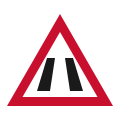
On a country road you see the road narrows sign. You slow down and look for oncoming traffic, but the sign does not say who goes first.

Legal reference: Reg. art. 84; CdS art. 39

Other dangers
Other dangers (Altri pericoli)

Exam traps

  • «It requires the driver to stop»: false, a warning sign never orders a stop.
  • «It di per sé (in itself) bans overtaking»: false, the ban comes from the visibility rule or a prohibitory sign.
  • «It gives priority»: false, priority comes from priority signs.
  • «A yellow background means a less serious hazard»: false, yellow only marks a temporary sign, for example at roadworks, with the same meaning.

Rule 2

Where they are placed

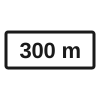
As a rule a warning sign is placed 150 metres before the hazard. In built up areas the distance can be shorter to suit the site. Where the standard distance cannot be kept, a supplementary panel gives the real one, and if there are junctions along the stretch the sign is repeated after each.

Example

Outside town you see a dangerous bend sign with no panel. The bend is about 150 metres ahead, and you brake on the straight before it.

Legal reference: Reg. art. 81, c. 7; Reg. art. 84

Distance panel
Distance panel (Pannello di distanza)

Exam traps

  • «Di norma (as a rule) 30 metres»: wrong figure, the standard is 150 metres.
  • «In built up areas sempre (always) 150 metres»: false, in towns the distance can be shorter.
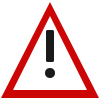
  • The general danger sign is used where no specific symbol exists, and a panel explains the hazard.

Rule 3

Bends, humps, dips and road surface

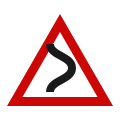
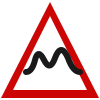
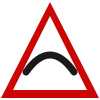
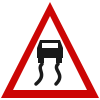
The bend and double bend signs show the shape of the road: the first curve of the symbol is the first bend you meet. A hump (dosso) is a rise that hides the road beyond its top; a dip (cunetta) is a hollow. The uneven road and slippery road (strada sdrucciolevole) signs warn of a rough or slippery surface, and the steep descent sign shows the gradient as a percentage.

Example

The sign shows a double bend turning right first. The first bend will be to the right, so you slow down before it.

Legal reference: Reg. art. 84

Double bend, first to the right
Double bend, first to the right (Doppia curva, la prima a destra)

Exam traps

  • Cunetta and dosso are opposites: a dip is not a bump to slow traffic.
  • On the steep descent sign the number is a gradient in per cent, not a speed.

Rule 4

Pedestrians, children, animals, rocks

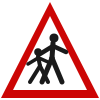
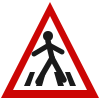
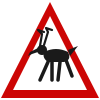
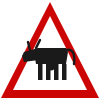
The pedestrian crossing and children signs warn that people may cross: you slow down and get ready to stop. The children sign goes wherever children are likely, not only outside schools. Domestic animals (animali domestici vaganti) means livestock; wild animals (animali selvatici vaganti) means game, also outside protected areas. Falling rocks also warns of stones already lying on the road.

Example

Near a playground you see the children sign. You ease off the accelerator and watch the gaps between parked cars.

Legal reference: Reg. art. 84

Children
Children (Bambini)

Exam traps

  • «Soltanto (only) outside primary schools»: false.
  • «Solo (only) in protected areas»: false. Domestic and wild are not the same.

Rule 5

Level crossings

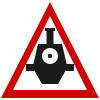
A level crossing without barriers is announced by the triangle sign and marked next to the rails by the St Andrew's cross (croce di Sant'Andrea). You only drive onto the rails if you are sure you can clear them at once. On and near the crossing stopping and parking are banned, and so is overtaking where there are no barriers.

Example

The queue stops just beyond a level crossing without barriers. You wait before the rails until there is room to get all the way across.

Legal reference: CdS art. 148, c. 13; CdS art. 158, c. 1

Level crossing without barriers
Level crossing without barriers (Passaggio a livello senza barriere)

Exam traps

  • «If the lights are not flashing»: that does not make overtaking legal at a crossing without barriers.

Rule 6

What can go wrong

Three episodes show that a warning sign must be read early and turned into action. First: on a Tuscan provincial road a triangular sign announces a dangerous bend to the right. The driver stays at 90 km/h until the entry of the bend and brakes there. Braking mid bend shifts weight forward, the rear wheels lose grip, the car slides towards the barrier. The rule in Reg. art. 84 places the sign about 150 metres in advance so that the driver can slow on the straight, not inside the bend. Second: in Val d'Aosta the falling rocks sign appears at the foot of a cliff. The driver does not slow because the sky is clear. Past the bend a stone the size of a fist is already on the carriageway. The impact cracks the sump and stops the car. The sign warns not only of rocks that may fall, but also of those already on the road. Third: near a playground in Verona the children sign sits before a long straight lined with parked cars. The driver assumes that with schools shut there is no need to slow. A child steps out between two parked cars and crosses. Art. 141 requires a speed suited to the likely presence of pedestrians, and the children sign is placed where minors are expected, not only outside schools. The thread is the translation from sign to action. A triangle with a red border means a hazard, and the hazard is handled by slowing down before, not at the point. A distance panel says where the hazard is, an extent panel how long the stretch is. When in doubt, faced with a general danger sign carrying an exclamation mark, lower your speed and look past the next bend.

Legal reference: Reg. art. 84; CdS art. 141

CdS: Codice della Strada (d.lgs. 285/1992). Reg.: its implementing regulation (d.P.R. 495/1992). c.: comma, the numbered paragraph of an article.

Full text of the Codice: www.aci.it/i-servizi/normative/codice-della-strada.html

Trap words

False statements on the exam often repeat a true rule and change a single word. These are the Italian words to read carefully in this topic. They stay in Italian because that is how they appear on the exam.

Words for this topic

dosso
hump, crest. A rise that hides the road beyond its top. Not to be confused with cunetta, a dip.
On and near a dosso (hump) overtaking, stopping and parking are all banned.
centro abitato
built up area. The zone between the town entry and exit signs; many rules differ inside and outside it.
Outside a centro abitato you park off the carriageway; inside it you pull in to the right hand edge.
preannuncia
announces ahead. It warns of something further along; it does not in itself order a specific action.
The uneven road sign preannuncia (announces) a rough surface: you slow down, you do not stop.
cunetta
dip. A hollow in the road surface, the opposite of a hump; not a speed bump.
Over a cunetta (dip) the risks are scraping the underside and losing grip for a moment.
sdrucciolevole
slippery. The sign warns of poor grip from rain, mud or a polished surface.
On a strada sdrucciolevole (slippery road) you brake and steer gently.

Words that appear in every topic

sempre
always. An absolute: the statement is true only if there is no exception at all.
«Keeping to the limit sempre (always) guarantees a safe speed»: false, in fog or on ice you go slower.
solo, soltanto, esclusivamente
only. It rules out every other case, so a single exception makes the statement false.
«The children sign is placed soltanto (only) outside primary schools»: false, it also appears near parks and sports grounds.
mai, in nessun caso
never, in no case. The statement is true only if the behaviour is not allowed in any situation.
«A driver with priority may in nessun caso (never) give it up»: false, they may, as long as they make it clear.
ovvero
In the language of the Codice it means «or» and introduces an alternative. It does not mean «that is».
Emergency stop: the vehicle has broken down ovvero (or) the driver must stop because they feel unwell (art. 157). Two separate cases; either one is enough.
obbligatoriamente, è obbligatorio
compulsory. A duty: it is not enough for the behaviour to be allowed, it must be required.
«Overtaking on the left is obbligatorio (compulsory) even past a driver turning left»: false, in that case you pass on the right.
è consentito, è ammesso
allowed, permitted. A permission, not a duty. «È consentito» does not mean «è obbligatorio», and the reverse.
«It is consentito (allowed) to pass on the right a driver who has signalled a left turn»: true, and art. 148(7) actually requires it.
di norma, di regola
as a rule, normally. It states the general rule, which allows exceptions, so the statement does not claim to hold in every case.
«Outside built up areas warning signs are placed di norma (as a rule) 150 metres ahead»: true, and a panel gives any other distance.
anche
also, even. It stretches the rule to one more case; ask whether that added case really belongs.
«The no parking sign anche (also) bans stopping»: false, a brief stop is still allowed under a no parking sign.
automaticamente, di per sé
automatically, in itself. It suggests an effect that applies on its own, when the effect usually depends on a sign or a specific condition.
«In fog the motorway limit automaticamente (automatically) drops to 90 km/h»: false, the automatic cut applies to rain and snow.
qualsiasi, qualunque, in ogni caso
any, in every case. It generalises; look for the category or situation the rule leaves out.
«The safe distance is the same at qualunque (any) speed»: false, it grows with speed.
corsia
lane. The part of the carriageway wide enough for one line of vehicles (art. 3).
A two way carriageway (carreggiata) usually has two corsie (lanes), one for each direction.
carreggiata
carriageway. The part of the road for vehicles, made up of one or more lanes (art. 3). It does not include the verge or the pavement.
A speed limit applies to the whole carreggiata (carriageway), not only to the lane next to the sign.
banchina
verge, hard strip. The strip beside the carriageway and outside it, not meant for driving (art. 3).
Outside built up areas you park off the carriageway, for example on a suitable banchina (verge) (art. 157(3)).
fermata
stop. A brief halt to let people get in or out, with the driver present and ready to move off (art. 157).
Pulling in to drop off a passenger and leaving straight away is a fermata (stop), not a sosta (parking).
sosta
parking. A prolonged halt during which the driver may leave the vehicle (art. 157).
A divieto di sosta (no parking) does not ban stopping; a divieto di fermata (no stopping) bans parking too.
arresto
halt. An interruption caused by traffic, such as a red light or a queue. It is not the driver's choice (art. 157).
Stopping at a red light is an arresto (halt); no stopping ban prevents it.
Check yourself

Three statements on the topic. Answer and see straight away whether the rule has stuck. These answers are not saved.

Question 1 of 1

  1. Fuori dei centri abitati i segnali di pericolo sono collocati di norma 30 metri prima del punto pericoloso.

    Outside built up areas warning signs are normally placed 30 metres before the hazard.

  2. Il segnale di pericolo doppia curva vieta di per sé il sorpasso.

    The double bend warning sign in itself bans overtaking.

    Triangular warning sign showing a double bend, the first to the right
  3. Il segnale di pericolo passaggio a livello senza barriere è completato dalla croce di Sant'Andrea posta a ridosso dei binari.

    The level crossing without barriers warning sign is completed by the St Andrew's cross placed next to the rails.

    Triangular warning sign showing a locomotive

Topic quiz: 22 statements

Untimed. After each answer you see the solution, the explanation, the trap words highlighted and a link back to the rule. At the end you get your score and can retest just the ones you missed.

Question 1 of 1

  1. I segnali di pericolo hanno forma triangolare con il vertice rivolto verso l'alto.

    Warning signs are triangular with the point facing upwards.

  2. Fuori dei centri abitati i segnali di pericolo sono collocati di norma 30 metri prima del punto pericoloso.

    Outside built up areas warning signs are normally placed 30 metres before the hazard.

  3. Il segnale di pericolo strada deformata obbliga il conducente ad arrestare il veicolo.

    The uneven road warning sign requires the driver to stop the vehicle.

    Triangular warning sign showing an uneven road surface
  4. Il segnale di pericolo doppia curva vieta di per sé il sorpasso.

    The double bend warning sign in itself bans overtaking.

    Triangular warning sign showing a double bend, the first to the right
  5. Il segnale di pericolo attraversamento pedonale preannuncia strisce pedonali sulla carreggiata.

    The pedestrian crossing warning sign announces a zebra crossing ahead.

    Triangular warning sign showing a pedestrian on a crossing
  6. Davanti a un passaggio a livello senza barriere è vietato impegnare i binari se non si è certi di poterli liberare subito.

    At a level crossing without barriers it is forbidden to enter the tracks unless they can be cleared immediately.

  7. Il segnale di pericolo discesa pericolosa riporta la pendenza espressa in percentuale.

    The steep descent warning sign shows the gradient as a percentage.

  8. Il segnale di pericolo animali selvatici vaganti si trova solo nelle aree protette.

    The wild animals warning sign is used only inside protected nature areas.

    Triangular warning sign showing a deer
  9. Il segnale di pericolo dosso preannuncia una variazione del profilo della strada che riduce la visibilità.

    The hump warning sign announces a change in the road profile that cuts visibility.

    Triangular warning sign showing the profile of a hump
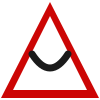
  10. Il segnale di pericolo cunetta indica un rilievo artificiale posto per rallentare il traffico.

    The dip warning sign marks an artificial hump built to slow traffic down.

    Triangular warning sign showing the profile of a dip
  11. Il segnale di pericolo strada sdrucciolevole segnala un tratto in cui la carreggiata può risultare scivolosa.

    The slippery road warning sign marks a stretch where the surface can become slippery.

    Triangular warning sign showing a car skidding
  12. Il segnale di pericolo bambini è posto soltanto davanti alle scuole elementari.

    The children warning sign is used only outside primary schools.

    Triangular warning sign showing two children
  13. Il segnale di pericolo generico è di norma accompagnato da un pannello che precisa la natura del pericolo.

    The other dangers sign is normally accompanied by a panel explaining the nature of the hazard.

    Triangular warning sign showing an exclamation mark
  14. Il segnale di pericolo animali domestici vaganti avverte della possibile presenza di selvaggina sulla carreggiata.

    The stray domestic animals sign warns that wild game may be on the carriageway.

    Triangular warning sign showing a cow
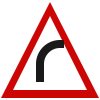
  15. Il segnale di pericolo curva a destra impone di ridurre la velocità prima di impegnare la curva.

    The right hand bend warning sign requires cutting speed before entering the bend.

    Triangular warning sign with a black band bending to the right
  16. Nei centri abitati i segnali di pericolo sono sempre collocati 150 metri prima del punto pericoloso.

    Inside built up areas warning signs are always placed 150 metres before the hazard.

  17. Il segnale di pericolo passaggio a livello senza barriere è completato dalla croce di Sant'Andrea posta a ridosso dei binari.

    The level crossing without barriers warning sign is completed by the St Andrew's cross placed next to the rails.

    Triangular warning sign showing a locomotive
  18. Il segnale di pericolo strettoia attribuisce la precedenza a chi lo incontra.

    The road narrows warning sign gives priority to the driver who meets it.

    Triangular warning sign showing the carriageway narrowing on both sides
  19. Il segnale di pericolo caduta massi avverte anche della possibile presenza di pietre già cadute sulla carreggiata.

    The falling rocks warning sign also warns that stones may already be lying on the carriageway.

  20. I segnali di pericolo a fondo giallo indicano un pericolo meno grave di quelli a fondo bianco.

    Warning signs on a yellow ground indicate a less serious hazard than those on a white ground.

  21. Nel segnale di pericolo doppia curva la prima piega del simbolo indica il verso della curva più vicina.

    On the double bend warning sign the first curve of the symbol shows which way the nearer bend turns.

  22. Il segnale triangolare con la sagoma di un aeroplano vieta il transito nelle vicinanze dell'aeroporto.

    The triangular sign showing an aeroplane bans traffic near the airport.

What next

All exam topics

Educational content. For the official rules, see the Codice della Strada and legal notes.