Lesson and quiz, category B licence

Supplementary panels (Pannelli integrativi)

On the exam this topic tests the supplementary panels under signs: distance, extent, hours and days, vehicle categories, exceptions and towing; this site has 20 true or false statements to practise on it.

The theory exam has 30 statements in 20 minutes and you pass with at most 3 mistakes. Source: Codice della Strada.

Skip to the quiz Study the rules

The real theory exam is in Italian, with French or German available on request. Lessons here keep the Italian terms in italics, and the quiz shows each statement in Italian with English help underneath. Switch to Italian only in the quiz to practise under exam conditions.

The rules

Question 1 of 1

Rule 1

What they are and where they go

A supplementary panel is a rectangle normally placed under the sign it refers to. It states where the sign applies, what it means, or for whom and when it applies, but it cannot contradict it: sign and panel are always read together. The normal background is white with black symbols and words; a yellow background is used with temporary roadworks signs. A panel is not required under every warning sign, but it is under the general danger sign, which on its own would not say what the danger is.

Example

Under a triangle with an exclamation mark there is a panel reading «incidente» (accident). The panel is what tells you the danger.

Legal reference: Reg. art. 83

Other dangers
Other dangers (Altri pericoli)

Exam traps

  • «They always go underneath the sign»: false, on the advance give way or stop sign the distance panel sits above (Reg. art. 108 c. 3).
  • «They normally have a blue background with white writing»: false, white background and black writing.
  • «Every warning sign must have a panel»: false, it is required only under the general danger sign.

Rule 2

Distance and extent

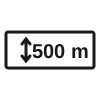
A distance panel, showing just a measurement, says how many metres remain to the point the sign refers to; it mostly goes with warning and priority signs. An extent panel says for how many metres or kilometres the hazard or rule continues, and is used with warnings and prohibitions alike (Reg. art. 83).

Example

Under the uneven road sign it says 300 m: the potholes start in 300 metres. With an extent panel reading 2 km, the rough stretch would last 2 kilometres.

Legal reference: Reg. art. 83

Extent panel
Extent panel (Pannello di estesa)

Exam traps

  • «300 m under a warning sign gives the length of the hazard»: false, it is the distance to where it starts.
  • «Extent is used only with warnings» and «distance only with prohibitions»: both false.

Rule 3

Arrows under parking signs: start, continuation, end

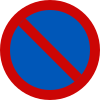
Under a no parking sign a horizontal arrow shows which way the ban runs from the post: depending on how it is drawn, it can mark the start, the continuation or the end. Two opposing arrows mean the ban runs both ways, before and after the sign. The tow away zone panel (zona rimozione) warns that a vehicle parked illegally can be removed, with towing and storage costs charged to the offender on top of the fine.

Example

The no parking sign has two opposing arrows beneath. You may not park a few metres before the post or a few metres after it.

Legal reference: Reg. art. 83; CdS art. 159

No parking
No parking (Divieto di sosta)

Exam traps

  • «A horizontal arrow sempre (always) marks the end of the ban»: false, it can also mark the start or continuation.

Rule 4

Hours and days

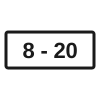
A time panel limits the sign to the hours shown: outside that band the rule does not apply, unless other signs say so. The same goes for days, such as weekdays only or market days.

Example

A no parking sign has a panel for weekdays from 8.00 to 13.00. If no other signs apply, you may park there all day on Sunday.

Legal reference: Reg. art. 83

Time panel
Time panel (Pannello con validità oraria)

Exam traps

  • If a statement extends the rule to hours or days not shown on the panel, it is false.

Rule 5

Categories and exceptions: the word eccetto

A vehicle symbol on its own limits the rule to that category: a lorry under a no entry for vehicles sign bans lorries only, a bicycle bans cycles only, a motorhome bans motorhomes only. To exclude a category the panel needs the word eccetto (except) before the symbol or text. «Eccetto residenti» exempts only people who live in the area, not those visiting them.

Example

You are going to dinner at a friend's in a street with a no entry sign and an except residents panel. You park outside and walk in, because the exception covers your friend, not the guest.

Legal reference: Reg. art. 83

Lorry silhouette panel
Lorry silhouette panel (Pannello con sagoma di autocarro)

Exam traps

  • «The lorry symbol means the sign does not apply to lorries»: false, it applies only to them.
  • «Except residents also covers visitors»: false.

Rule 6

What can go wrong

Three scenes show that ignoring a panel changes the whole sign. First scene: in Rome, near a local market, a driver parks under a no parking sign because it is early morning and he assumes the ban covers only market hours. The panel, however, shows a tow away zone and a time band that has already started. When he comes back an hour later the car is gone: it has been towed, and on top of the fine he pays for towing and storage. Under art. 83 of the Regolamento the panel is part of the sign and is read with it. Second scene: in Verona a removal van enters a street with a no entry for vehicles sign and a lorry symbol beneath. The driver reads the symbol as excluding heavy vehicles from the ban and drives on. It means the opposite: without the word eccetto the symbol limits the ban to lorries, and his vehicle in that category could not enter. The local police record the offence. Third scene: on a stretch of the Brenner state road an uneven road sign has a 500 m panel beneath. The driver takes it as the length of the damaged stretch, speeds up after half a kilometre thinking the hazard is over, and hits a deep pothole at full speed, bending a wheel rim. The panel with just a measurement gave the distance to the start of the hazard, not its extent, which is shown with the double arrow. The shared lesson is simple. A panel is not a detail: a measurement without arrows is a distance, a symbol without eccetto narrows the rule to that category, and time bands and tow away zones change the price of a wrong parking choice.

Legal reference: Reg. art. 83

CdS: Codice della Strada (d.lgs. 285/1992). Reg.: its implementing regulation (d.P.R. 495/1992). c.: comma, the numbered paragraph of an article.

Full text of the Codice: www.aci.it/i-servizi/normative/codice-della-strada.html

Trap words

False statements on the exam often repeat a true rule and change a single word. These are the Italian words to read carefully in this topic. They stay in Italian because that is how they appear on the exam.

Words that appear in every topic

sempre
always. An absolute: the statement is true only if there is no exception at all.
«Keeping to the limit sempre (always) guarantees a safe speed»: false, in fog or on ice you go slower.
solo, soltanto, esclusivamente
only. It rules out every other case, so a single exception makes the statement false.
«The children sign is placed soltanto (only) outside primary schools»: false, it also appears near parks and sports grounds.
mai, in nessun caso
never, in no case. The statement is true only if the behaviour is not allowed in any situation.
«A driver with priority may in nessun caso (never) give it up»: false, they may, as long as they make it clear.
ovvero
In the language of the Codice it means «or» and introduces an alternative. It does not mean «that is».
Emergency stop: the vehicle has broken down ovvero (or) the driver must stop because they feel unwell (art. 157). Two separate cases; either one is enough.
obbligatoriamente, è obbligatorio
compulsory. A duty: it is not enough for the behaviour to be allowed, it must be required.
«Overtaking on the left is obbligatorio (compulsory) even past a driver turning left»: false, in that case you pass on the right.
è consentito, è ammesso
allowed, permitted. A permission, not a duty. «È consentito» does not mean «è obbligatorio», and the reverse.
«It is consentito (allowed) to pass on the right a driver who has signalled a left turn»: true, and art. 148(7) actually requires it.
di norma, di regola
as a rule, normally. It states the general rule, which allows exceptions, so the statement does not claim to hold in every case.
«Outside built up areas warning signs are placed di norma (as a rule) 150 metres ahead»: true, and a panel gives any other distance.
anche
also, even. It stretches the rule to one more case; ask whether that added case really belongs.
«The no parking sign anche (also) bans stopping»: false, a brief stop is still allowed under a no parking sign.
automaticamente, di per sé
automatically, in itself. It suggests an effect that applies on its own, when the effect usually depends on a sign or a specific condition.
«In fog the motorway limit automaticamente (automatically) drops to 90 km/h»: false, the automatic cut applies to rain and snow.
qualsiasi, qualunque, in ogni caso
any, in every case. It generalises; look for the category or situation the rule leaves out.
«The safe distance is the same at qualunque (any) speed»: false, it grows with speed.
corsia
lane. The part of the carriageway wide enough for one line of vehicles (art. 3).
A two way carriageway (carreggiata) usually has two corsie (lanes), one for each direction.
carreggiata
carriageway. The part of the road for vehicles, made up of one or more lanes (art. 3). It does not include the verge or the pavement.
A speed limit applies to the whole carreggiata (carriageway), not only to the lane next to the sign.
banchina
verge, hard strip. The strip beside the carriageway and outside it, not meant for driving (art. 3).
Outside built up areas you park off the carriageway, for example on a suitable banchina (verge) (art. 157(3)).
fermata
stop. A brief halt to let people get in or out, with the driver present and ready to move off (art. 157).
Pulling in to drop off a passenger and leaving straight away is a fermata (stop), not a sosta (parking).
sosta
parking. A prolonged halt during which the driver may leave the vehicle (art. 157).
A divieto di sosta (no parking) does not ban stopping; a divieto di fermata (no stopping) bans parking too.
arresto
halt. An interruption caused by traffic, such as a red light or a queue. It is not the driver's choice (art. 157).
Stopping at a red light is an arresto (halt); no stopping ban prevents it.

Check yourself

Three statements on the topic. Answer and see straight away whether the rule has stuck. These answers are not saved.

Question 1 of 1

  1. Un pannello con la scritta 300 m sotto un segnale di pericolo indica la lunghezza del tratto pericoloso.

    A panel reading 300 m under a warning sign gives the length of the hazardous stretch.

  2. Il pannello con la sagoma di un autocarro indica che il segnale sovrastante non si applica agli autocarri.

    A panel showing a lorry silhouette means the sign above does not apply to lorries.

  3. Il pannello eccetto residenti autorizza anche chi si reca in visita da un residente.

    An except residents panel also allows people visiting a resident.

Topic quiz: 20 statements

Untimed. After each answer you see the solution, the explanation, the trap words highlighted and a link back to the rule. At the end you get your score and can retest just the ones you missed.

Question 1 of 1

  1. Il pannello integrativo posto sotto un segnale ne precisa il significato o il campo di applicazione.

    A supplementary panel under a sign specifies its meaning or scope.

  2. Un pannello con la scritta 300 m sotto un segnale di pericolo indica la lunghezza del tratto pericoloso.

    A panel reading 300 m under a warning sign gives the length of the hazardous stretch.

  3. Il pannello di estesa indica per quanti metri prosegue la prescrizione o il pericolo.

    An extent panel shows for how many metres the rule or hazard continues.

  4. Un pannello con la scritta eccetto residenti esclude dal divieto chi abita nella zona.

    A panel reading except residents exempts people living in the area from the ban.

  5. Il pannello con la sagoma di un autocarro indica che il segnale sovrastante non si applica agli autocarri.

    A panel showing a lorry silhouette means the sign above does not apply to lorries.

  6. Il pannello con indicazione oraria rende il divieto valido solo nelle ore indicate.

    A time panel makes the restriction valid only during the hours shown.

  7. Il pannello con la freccia orizzontale sotto un divieto di sosta indica sempre la fine del divieto.

    A horizontal arrow panel under a no parking sign always marks the end of the ban.

  8. I pannelli integrativi possono essere collocati anche sopra il segnale a cui si riferiscono.

    Supplementary panels may also be placed above the sign they refer to.

  9. Un pannello integrativo può escludere dalla prescrizione una categoria di utenti indicandola dopo la parola eccetto.

    A supplementary panel can exempt a category of users by naming it after the word except.

  10. Un pannello con due frecce contrapposte sotto un divieto di sosta indica che il divieto si sviluppa in entrambe le direzioni rispetto al segnale.

    A panel with two opposed arrows under a no parking sign shows the ban runs in both directions from the sign.

  11. Il pannello zona rimozione avverte che il veicolo lasciato in sosta vietata può essere rimosso a spese del proprietario.

    The tow away zone panel warns that a vehicle left parked illegally may be removed at the owner's expense.

  12. Un pannello che indica gli orari e i giorni feriali limita la prescrizione a quelle giornate.

    A panel giving times and weekdays (Monday to Saturday, public holidays excluded) limits the rule to those days.

  13. Il pannello con la sagoma di una bicicletta sotto un divieto di transito rende il divieto valido per i soli velocipedi.

    A panel showing a bicycle under a no vehicles sign makes the ban apply to pedal cycles only.

  14. Un pannello integrativo può contraddire il segnale sotto cui è posto.

    A supplementary panel can contradict the sign it hangs under.

  15. Il pannello di estesa può essere usato soltanto con i segnali di pericolo.

    The extent panel may be used only with warning signs.

  16. Un pannello con il simbolo di un autocaravan esclude i camper dalla prescrizione del segnale.

    A panel showing a motorhome exempts motorhomes from the rule on the sign.

  17. I pannelli integrativi hanno di regola fondo blu con scritte bianche.

    Supplementary panels normally have a blue ground with white lettering.

  18. Il pannello che indica una distanza si usa soltanto con i segnali di divieto.

    The distance panel is used only with prohibitory signs.

  19. Il pannello eccetto residenti autorizza anche chi si reca in visita da un residente.

    An except residents panel also allows people visiting a resident.

  20. Ogni segnale di pericolo deve essere accompagnato da un pannello integrativo.

    Every warning sign must carry a supplementary panel.

What next

All exam topics

Educational content. For the official rules, see the Codice della Strada and legal notes.