Lesson and quiz, category B licence

Right of way rules (Norme sulla precedenza)

On the exam this topic tests who goes first at unmarked junctions, at roundabouts, when leaving private accesses, when turning, and when officers or emergency vehicles are involved; this site has 22 true or false statements to practise on it.

The theory exam has 30 statements in 20 minutes and you pass with at most 3 mistakes. Source: Codice della Strada.

Skip to the quiz Study the rules

The real theory exam is in Italian, with French or German available on request. Lessons here keep the Italian terms in italics, and the quiz shows each statement in Italian with English help underneath. Switch to Italian only in the quiz to practise under exam conditions.

The rules

Question 1 of 1

Rule 1

With no signs, traffic from the right goes first

When two vehicles' paths cross and there are no signs, lights or officers, you give way to the vehicle coming from your right (precedenza a destra). Anyone approaching a junction must still take the greatest care, and must not enter it (impegnare l'incrocio) unless they can clear it quickly.

Example

You reach an unmarked junction and a car appears from the road on your right. It goes first, even if your road is wider or surfaced and the other is a dirt track.

Legal reference: CdS art. 145, c. 1, 2, 7

Unmarked junction: traffic from the right goes first You: give way From your right: goes
No signs and no lights: let the vehicle on your right go first.

Exam traps

  • «A driver on a surfaced road sempre (always) has priority»: the surface, width or importance of a road gives no priority. Signs decide, and with no signs the right hand rule applies.
  • «A driver with priority may enter the junction even if they will not clear it»: false. Priority never allows blocking the junction.
  • «They may in nessun caso (never) give it up»: priority can be given up, as long as it is clear and does not force others into sudden moves.

Rule 2

A driver joining traffic gives way

A driver entering the road from a private access, a driveway (passo carrabile), a service area or a track must stop and give way to traffic already on the road. The same applies when moving off after parking and when joining a motorway from the acceleration lane (corsia di accelerazione).

Example

You pull out of your courtyard and a car approaches from your left. The right hand rule does not apply, because a driveway is not a junction: you stop and let it pass.

Legal reference: CdS art. 145, c. 6, 8; CdS art. 154

Exam traps

  • Statements that give priority to the driver joining (chi si immette) are almost always false: whoever enters the flow lets moving traffic pass.
  • The acceleration lane is for building up speed and gives no right to cut in. Priority stays with traffic on the carriageway (carreggiata).

Rule 3

Roundabouts: the sign at the entry decides

The Codice has no special roundabout rule. If there is a give way sign (dare precedenza) at the entry, as there is at most roundabouts, vehicles already on the ring go first. If there is no sign, the general right hand rule applies.

Example

There is an upside down triangle at the entry and a car is coming round the ring from your left. You wait for it to pass, then enter.

Legal reference: CdS art. 145, c. 2, 4

Roundabout with give way at the entry On the ring: goes give way sign At the entry: waits
With the sign at the entry, traffic on the ring goes first. With no sign, the right hand rule applies.

Exam traps

  • «Vehicles on the ring sempre (always) have priority»: true only with a give way sign at the entry. Check whether the statement says the roundabout has signs or is priva di segnaletica (unsigned).

Rule 4

Turning, U-turns, pedestrians and cyclists

A driver changing direction must do so without creating danger: when turning left you let oncoming traffic through, and when making a U-turn (inversione di marcia) you let everyone through. You give way to cyclists on a cycle lane you cross, and to pedestrians on a zebra crossing or right next to it, where traffic is not controlled by officers or lights.

Example

On a green light you turn left while a car comes straight towards you from the other direction. You wait in the middle of the junction for it to pass, then finish the turn.

Legal reference: CdS art. 154, c. 1; CdS art. 145, c. 4-bis, 4-ter; CdS art. 191, c. 1; CdS art. 41, c. 9

Exam traps

  • «Pedestrians who have già (already) started crossing»: true, but the duty is wider and also covers people right next to the crossing.
  • Green means you may go, not that you may push past vehicles still clearing the junction.

Rule 5

Officers, flashing amber and emergency vehicles

A traffic officer's signals cancel every other instruction, lights and signs included. On a flashing amber light you go on slowly, following the normal priority rules. When you hear the siren of police, fire or ambulance services you clear the way and stop if needed; those vehicles are exempt from the rules only with siren and blue lights (dispositivi acustici e luminosi) on together.

Example

The light is green but an officer in the middle of the junction holds up a palm towards you. You stop, because the officer's signal wins.

Legal reference: CdS art. 43, c. 2; CdS art. 41, c. 17; CdS art. 177

Exam traps

  • «Anche (even) when siren and lights are off»: false, the exemption needs siren and lights on together.
  • «A flashing amber light gives priority»: false, it only means the signals are not controlling the junction.

Rule 6

Trams, narrow sections and mountain roads

At junctions you give way to rail vehicles such as trams, unless signs say otherwise. Where an obstacle blocks one side of the road, the driver on the blocked side stops. On narrow, steep mountain roads the driver going downhill stops and pulls over; if someone must reverse, between vehicles of the same category it is the one going downhill, unless reversing is clearly easier for the one going up.

Example

On a mountain road a car coming down meets yours going up and there is no room to pass. The car going downhill reverses to the nearest passing place.

Legal reference: CdS art. 145, c. 3; CdS art. 150, c. 1, 2, 3

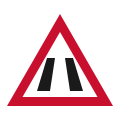
Road narrows on both sides
Road narrows on both sides (Strettoia simmetrica)

Exam traps

  • «In a narrow section the larger vehicle goes first»: no rule says so, and the narrow road warning sign assigns no priority.
  • «The vehicle going uphill must reverse»: false as a general rule, it is the one going downhill.

Rule 7

What can go wrong

Three scenes show how a misread priority turns into a real crash. First scene: at a roundabout on via Emilia in Bologna the give way sign is clear at the entry. A car comes up fast from the left inside the ring. The driver enters, sure that a bigger car wins. The car on the ring brakes and is hit on the rear right wheel. Fault stays with the driver who joined the ring, because art. 145 of the Codice della Strada gives priority to traffic already on the roundabout when there is an inverted triangle. Second scene: a junction in a residential area of Milan has no signs. The main street is surfaced, the side street is cobbled. The driver goes straight on, thinking the surfaced road wins. A small car appears from the right with the same right to pass, because the road surface does not count. A side impact on the right door, bodywork damage, and a fine for the driver who denied priority to the right. Third scene: on the Turin ring road an ambulance runs with siren and blue lights on together. The driver brakes sharply in the middle of the lane instead of pulling over to the right to clear the way. The car behind runs into them. The duty under art. 177 is not to stop in the middle; it is to make way for the emergency vehicle, which means slowing down, moving towards the right edge and stopping only if needed. The shared lesson is simple. Priority to the right holds until a sign says otherwise, a roundabout follows the sign at the entry, and a driver joining traffic lets moving vehicles pass. When in doubt, slow down and catch the other driver's eye, because a predictable manoeuvre is safer than a claimed right of way.

Legal reference: CdS art. 145; CdS art. 177

CdS: Codice della Strada (d.lgs. 285/1992). Reg.: its implementing regulation (d.P.R. 495/1992). c.: comma, the numbered paragraph of an article.

Full text of the Codice: www.aci.it/i-servizi/normative/codice-della-strada.html

Trap words

False statements on the exam often repeat a true rule and change a single word. These are the Italian words to read carefully in this topic. They stay in Italian because that is how they appear on the exam.

Words for this topic

da destra
from the right. The default rule at unmarked junctions: the vehicle arriving from your right goes first.
The side is judged from your own seat, not from which road looks more important.
immettersi
to join, to merge. Entering traffic from a driveway, a parking place or a slip lane; the driver joining gives way.
«A driver joining from the acceleration lane has priority»: false.
impegnare
to enter and occupy an area such as a junction. You do not enter a junction you cannot clear quickly.
«A driver with priority may impegnare (enter) the junction even if they cannot clear it»: false (art. 145(7)).
dispositivi acustici e luminosi
siren and blue flashing lights. Emergency vehicles are exempt from traffic rules only with both switched on together.
An ambulance with neither siren nor lights on is treated like any other vehicle.
già
already. It narrows the case to someone who has started; check whether the rule also covers someone about to start.
Pedestrians get priority on the crossing and also when they are right next to it (art. 191).
passo carrabile
vehicle access, driveway. Parking in front of it is banned, and a driver coming out of it gives way.
A driver leaving a passo carrabile (driveway) does not use the right hand rule: they stop and let traffic pass.

Words that appear in every topic

sempre
always. An absolute: the statement is true only if there is no exception at all.
«Keeping to the limit sempre (always) guarantees a safe speed»: false, in fog or on ice you go slower.
solo, soltanto, esclusivamente
only. It rules out every other case, so a single exception makes the statement false.
«The children sign is placed soltanto (only) outside primary schools»: false, it also appears near parks and sports grounds.
mai, in nessun caso
never, in no case. The statement is true only if the behaviour is not allowed in any situation.
«A driver with priority may in nessun caso (never) give it up»: false, they may, as long as they make it clear.
ovvero
In the language of the Codice it means «or» and introduces an alternative. It does not mean «that is».
Emergency stop: the vehicle has broken down ovvero (or) the driver must stop because they feel unwell (art. 157). Two separate cases; either one is enough.
obbligatoriamente, è obbligatorio
compulsory. A duty: it is not enough for the behaviour to be allowed, it must be required.
«Overtaking on the left is obbligatorio (compulsory) even past a driver turning left»: false, in that case you pass on the right.
è consentito, è ammesso
allowed, permitted. A permission, not a duty. «È consentito» does not mean «è obbligatorio», and the reverse.
«It is consentito (allowed) to pass on the right a driver who has signalled a left turn»: true, and art. 148(7) actually requires it.
di norma, di regola
as a rule, normally. It states the general rule, which allows exceptions, so the statement does not claim to hold in every case.
«Outside built up areas warning signs are placed di norma (as a rule) 150 metres ahead»: true, and a panel gives any other distance.
anche
also, even. It stretches the rule to one more case; ask whether that added case really belongs.
«The no parking sign anche (also) bans stopping»: false, a brief stop is still allowed under a no parking sign.
automaticamente, di per sé
automatically, in itself. It suggests an effect that applies on its own, when the effect usually depends on a sign or a specific condition.
«In fog the motorway limit automaticamente (automatically) drops to 90 km/h»: false, the automatic cut applies to rain and snow.
qualsiasi, qualunque, in ogni caso
any, in every case. It generalises; look for the category or situation the rule leaves out.
«The safe distance is the same at qualunque (any) speed»: false, it grows with speed.
corsia
lane. The part of the carriageway wide enough for one line of vehicles (art. 3).
A two way carriageway (carreggiata) usually has two corsie (lanes), one for each direction.
carreggiata
carriageway. The part of the road for vehicles, made up of one or more lanes (art. 3). It does not include the verge or the pavement.
A speed limit applies to the whole carreggiata (carriageway), not only to the lane next to the sign.
banchina
verge, hard strip. The strip beside the carriageway and outside it, not meant for driving (art. 3).
Outside built up areas you park off the carriageway, for example on a suitable banchina (verge) (art. 157(3)).
fermata
stop. A brief halt to let people get in or out, with the driver present and ready to move off (art. 157).
Pulling in to drop off a passenger and leaving straight away is a fermata (stop), not a sosta (parking).
sosta
parking. A prolonged halt during which the driver may leave the vehicle (art. 157).
A divieto di sosta (no parking) does not ban stopping; a divieto di fermata (no stopping) bans parking too.
arresto
halt. An interruption caused by traffic, such as a red light or a queue. It is not the driver's choice (art. 157).
Stopping at a red light is an arresto (halt); no stopping ban prevents it.
Check yourself

Three statements on the topic. Answer and see straight away whether the rule has stuck. These answers are not saved.

Question 1 of 1

  1. Agli incroci privi di segnaletica si deve dare la precedenza ai veicoli che provengono da destra.

    At junctions without signs, priority goes to vehicles coming from the right.

  2. Chi esce da un passo carrabile per immettersi nella strada ha la precedenza sui veicoli in transito.

    A driver leaving a private driveway has priority over vehicles already on the road.

  3. La luce gialla lampeggiante di un semaforo attribuisce la precedenza a chi la incontra.

    A flashing amber traffic light gives priority to the driver who meets it.

Topic quiz: 22 statements

Untimed. After each answer you see the solution, the explanation, the trap words highlighted and a link back to the rule. At the end you get your score and can retest just the ones you missed.

Question 1 of 1

  1. Agli incroci privi di segnaletica si deve dare la precedenza ai veicoli che provengono da destra.

    At junctions without signs, priority goes to vehicles coming from the right.

  2. I veicoli su rotaia hanno la precedenza sugli altri veicoli salvo diversa segnalazione.

    Rail vehicles have priority over other vehicles unless signs say otherwise.

  3. Chi esce da un passo carrabile per immettersi nella strada ha la precedenza sui veicoli in transito.

    A driver leaving a private driveway has priority over vehicles already on the road.

  4. Nelle rotatorie con segnale di dare precedenza all'ingresso passa prima chi si trova già nell'anello.

    At roundabouts with a give way sign at the entry, vehicles already circulating go first.

  5. I veicoli di polizia, vigili del fuoco e ambulanze in servizio di emergenza hanno diritto di precedenza quando usano i dispositivi acustici e luminosi.

    Police, fire and ambulance vehicles on emergency duty have priority when using siren and beacons.

  6. Su una strada stretta e a forte pendenza, dove due veicoli non possono passare insieme, deve retrocedere chi sale.

    On a narrow steep road where two vehicles cannot pass, the vehicle going uphill must reverse.

  7. Chi svolta a sinistra deve dare la precedenza ai veicoli che provengono in senso opposto.

    A driver turning left must give way to oncoming vehicles.

  8. Il conducente che intende immettersi nel flusso della circolazione dopo una sosta ha la precedenza.

    A driver moving back into traffic after parking has priority.

  9. In una rotatoria priva di segnaletica chi entra deve dare la precedenza ai veicoli che provengono da destra.

    At a roundabout with no signing, a driver entering must give way to vehicles coming from the right.

  10. Il conducente deve dare la precedenza ai pedoni che hanno già iniziato l'attraversamento sulle strisce.

    A driver must give way to pedestrians who have already started to cross on a zebra crossing.

  11. Le indicazioni di un agente del traffico prevalgono sui segnali stradali e sulle luci semaforiche.

    The signals of a traffic officer prevail over road signs and over traffic lights.

  12. Chi svolta deve lasciare passare i ciclisti che percorrono la pista ciclabile che sta per tagliare.

    A driver turning must let through cyclists on the cycle track they are about to cross.

  13. Con il semaforo verde occorre comunque dare la precedenza ai veicoli che stanno ancora liberando l'incrocio.

    On a green light a driver must still give way to vehicles still clearing the junction.

  14. Chi effettua l'inversione di marcia deve dare la precedenza a tutti gli altri veicoli.

    A driver making a U-turn must give way to all other vehicles.

  15. Chi esce da un'area di servizio per immettersi sulla strada deve dare la precedenza ai veicoli in transito.

    A driver leaving a service area to join the road must give way to passing traffic.

  16. La luce gialla lampeggiante di un semaforo attribuisce la precedenza a chi la incontra.

    A flashing amber traffic light gives priority to the driver who meets it.

  17. Chi ha la precedenza può impegnare l'incrocio anche quando è prevedibile che non riuscirà a liberarlo.

    A driver with priority may enter the junction even when it is clear they will not be able to clear it.

  18. Chi percorre una strada asfaltata ha sempre la precedenza su chi proviene da una strada sterrata.

    A driver on a surfaced road always has priority over one coming from an unsurfaced road.

  19. In una strettoia segnalata soltanto dal segnale di pericolo passa per primo il veicolo di dimensioni maggiori.

    In a narrow section marked only by a warning sign the larger vehicle goes first.

    Triangular warning sign showing the carriageway narrowing on both sides
  20. Chi si immette in autostrada dalla corsia di accelerazione ha la precedenza sui veicoli che già percorrono la carreggiata.

    A driver joining the motorway from the acceleration lane has priority over vehicles already on the carriageway.

  21. Il conducente che ha la precedenza non può in nessun caso cederla.

    A driver who has priority may never give it up.

  22. I veicoli in servizio di emergenza hanno la precedenza anche quando non azionano i dispositivi acustici e luminosi.

    Emergency vehicles on emergency duty have priority even when siren and beacons are switched off.

What next

All exam topics

Educational content. For the official rules, see the Codice della Strada and legal notes.